The Medium Controls the Present: Is it Too Late to Stop a Digital Dark Age?

“He who controls the past controls the future. He who controls the present controls the past.” ― George Orwell, 1984

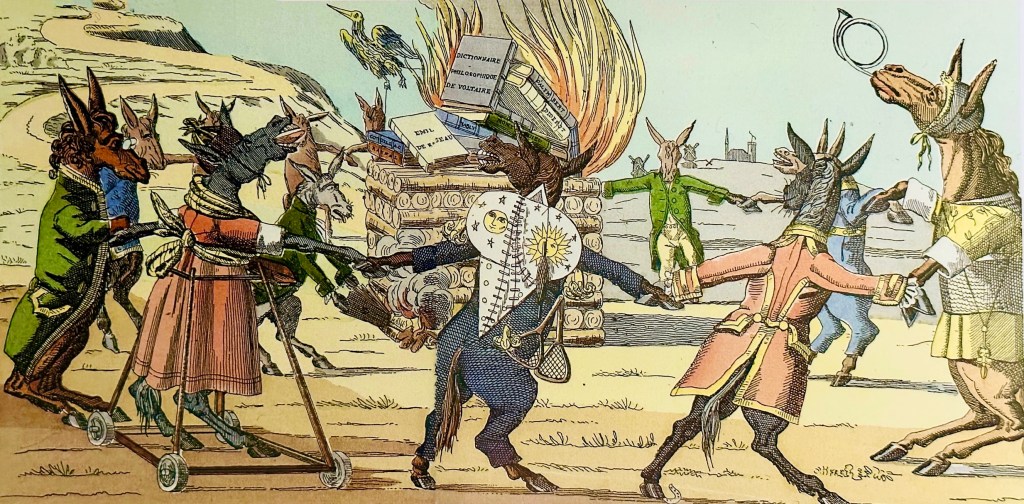
A few short pre-Covid years ago, Google Vice President Vint Cerf turned some heads at the annual meeting of the American Association for the Advancement of Science in San Jose, warning the attending scientists that the digitization of the artifacts of civilization may create a digital dark age. “If we’re thinking 1,000 years, 3,000 years ahead in the future, we have to ask ourselves, how do we preserve all the bits that we need in order to correctly interpret the digital objects we create?” Cerf’s concerns are that today’s technology will become obsolete at some future time, with the information of our own times locked in a technological prison.

(more…)

Veteran’s Day 2016 and Civic Courage

Robert Gould Shaw memorial
Photo by the author of the Robert Gould Shaw and the 54th Massachusetts Infantry Memorial in Boston

The memorial pictured that sits on Boston Common marks a bit of history that is but an echo of an earlier time to us, it affected me greatly when I actually saw it up close, for it spoke to me.  I felt a kinship over time and space to those men who are represented in bronze and stone and what they might have been thinking as they marched in the cause of equality for all people, of self-government, and of a steady intolerance of extremism, ruthlessness, and violence in defense of a cause, which cause itself was morally repugnant; fear, no doubt, trepidation, hope, pride, and steely resolve to acquit themselves well when the time came for them to do their duty.  It was a time where warfare was very close and personal.

(more…)

Family Affair — Part III — Private Monopsony, Monopoly, and the Disaccumulation of Capital

It’s always good to be ahead of the power curve.  I see that the eminent Paul Krugman had an editorial in the New York Times about the very issues that I’ve dealt with in this blog, his example in this case being Amazon.  This is just one of many articles that have been raised about the monopsony power as a result of the Hatchette controversy.  In The New Republic Franklin Foer also addresses this issue at length in the article “Amazon Must Be Stopped.”  In my last post on this topic I discussed public monopsony, an area in which I have a great deal of expertise.  But those of us in the information world that are not Microsoft, Oracle, Google, or one of the other giants also live in the world of private monopsony.

(more…)

Family Affair — Part II — The Micro and Managerial Economics of Projects under Public Monopsony

In my last post I summarized by the macroeconomic environment in which we operate and delved into some discussion of microeconomic foundations.  The response was positive if lukewarm overall, but ego-boosting is not why I started a blog.  One of my readers once asked why I don’t take on some hot button issues.  Well that’s not my role or area of expertise.  I’m not a politician or a social commentator.  The community I inhabit has a large impact but is relatively small and mostly consists of engineers, scientists, mathematicians, some policy-makers, thought leaders, and other technically-focused professionals.  I’m not trying to stir up emotions.  I’m out to stimulate discussion and thought.  I’m relieved that I don’t get trolls when posting factual information that goes against popular misconceptions.  They are a waste of time.

(more…)

Family Affair — Part I — Managerial Economics of Projects, Microeconomic Foundations, and Macro

A little more than a week ago I had an interesting conversation on a number of topics with colleagues in attending the National Defense Industrial Association Integrated Program Management Division (NDIA IPMD).  A continuation of one of those discussions ended up in the comments section of my post “Mo’Better Risk–Tournaments and Games of Failure Part II” by Mark Phillips.  I think it is worthwhile to read Mark’s comments because within them lie the crux of the discussion that is going on not only in our own community, but in the country as a whole, particularly in the economics profession, that will eventually influence and become public policy.*

(more…)