The Medium Controls the Present: Is it Too Late to Stop a Digital Dark Age?

“He who controls the past controls the future. He who controls the present controls the past.” ― George Orwell, 1984

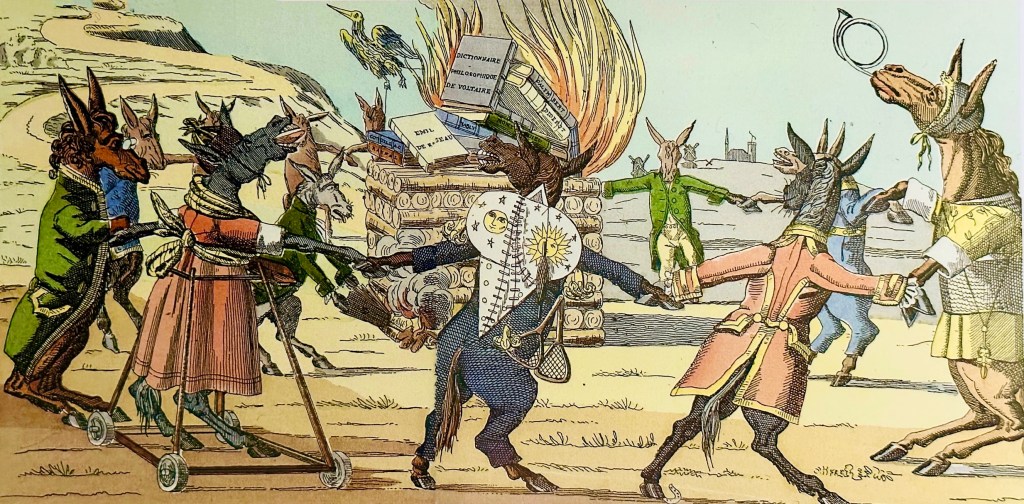
A few short pre-Covid years ago, Google Vice President Vint Cerf turned some heads at the annual meeting of the American Association for the Advancement of Science in San Jose, warning the attending scientists that the digitization of the artifacts of civilization may create a digital dark age. “If we’re thinking 1,000 years, 3,000 years ahead in the future, we have to ask ourselves, how do we preserve all the bits that we need in order to correctly interpret the digital objects we create?” Cerf’s concerns are that today’s technology will become obsolete at some future time, with the information of our own times locked in a technological prison.

(more…)

Red Queen Race: Project Management and Running Against Time

“Well, in our country,” said Alice, still panting a little, “you’d generally get to somewhere else—if you run very fast for a long time, as we’ve been doing.”

“A slow sort of country!” said the Queen. “Now, here, you see, it takes all the running you can do, to keep in the same place. If you want to get somewhere else, you must run at least twice as fast, as that!” —Through the Looking-Glass and What Alice Found There, Chapter 2, Lewis Carroll

There have been a number of high profile examples over the last several years concerning project management failure and success. For example, in the former case, the initial rollout of the Affordable Care Act marketplace web portal was one of these, and the causes for its faults took a while to understand, absent political bias. The reasons, as the linked article show, are prosaic and basic to the discipline of project management.

(more…)

Shake it Out – Embracing the Future of Program Management – Part Two: Private Industry Program and Project Management in Aerospace, Space, and Defense

In my previous post, I focused on Program and Project Management in the Public Interest, and the characteristics of its environment, especially from the perspective of the government program and acquisition disciplines. The purpose of this exploration is to lay the groundwork for understanding the future of program management—and the resulting technological and organizational challenges that are required to support that change.

The next part of this exploration is to define the motivations, characteristics, and disciplines of private industry equivalencies. Here there are commonalities, but also significant differences, that relate to the relationship and interplay between public investment, policy and acquisition, and private business interests.

(more…)

Shake it Out – Embracing the Future in Program Management – Part One: Program and Project Management in the Public Interest

I heard the song from which I derived the title to this post sung by Florence and the Machine and was inspired to sit down and write about what I see as the future in program management.

Thus, my blogging radio silence has ended as I begin to process and share my observations and essential achievements over the last couple of years.

My company—the conduit that provides the insights I share here—is SNA Software LLC. We are a small, veteran-owned company and we specialize in data capture, transformation, contextualization and visualization. We do it in a way that removes significant effort in these processes, ensures reliability and trust, to incorporate off-the-shelf functionality that provides insight, and empowers the user by leveraging the power of open systems, especially in program and project management.

Program and Project Management in the Public Interest

There are two aspects to the business world that we inhabit: commercial and government; both, however, usually relate to some aspect of the public interest, which is our forte.

There are also two concepts about this subject to unpack.

(more…)

Open: Strategic Planning, Open Data Systems, and the Section 809 Panel

Sundays are usually days reserved for music and the group Rhye was playing in the background when this topic came to mind.

I have been preparing for my presentation in collaboration with my Navy colleague John Collins for the upcoming Integrated Program Management Workshop in Baltimore. This presentation will be a non-proprietary/non-commercial talk about understanding the issue of unlocking data to support national defense systems, but the topic has broader interest.

Thus, in advance of that formal presentation in Baltimore, there are issues and principles that are useful to cover, given that data capture and its processing, delivery, and use is at the heart of all systems in government, and private industry and organizations.

(more…)

Sledgehammer: Pisano Talks!

My blogging hiatus is coming to an end as I take a sledgehammer to the writer’s block wall.

I’ve traveled far and wide over the last six months to various venues across the country and have collected a number of new and interesting perspectives on the issues of data transformation, integrated project management, and business analytics and visualization. As a result, I have developed some very strong opinions regarding the trends that work and those that don’t regarding these topics and will be sharing these perspectives (with the appropriate supporting documentation per usual) in following posts.

To get things started this post will be relatively brief.

(more…)

Take Me To The River, Part 3, Technical Performance and Risk Management Digital Elements of Integrated Program Management

Part three of this series of articles on the elements of Integrated Program and Project Management will focus on two additional areas of IPM: technical performance and risk management. Prior to jumping in, however–and given the timeframe over which I’ve written this series–a summary to date is in order.

(more…)

Ch- Ch- Changes–What I Learned at the NDIA IPMD Meeting and Last Thoughts on POGO DCMA

Hot Topics at the National Defense Industrial Association’s Integrated Program Management Division (NDIA-IPMD)

For those of you who did not attend, or who have a passing interest in what is happening in the public sphere of DoD acquisition, the NDIA IPMD meeting held last week was a great importance. Here are the highlights.

(more…)

Back to School Daze Blogging–DCMA Investigation on POGO, DDSTOP, $600 Ashtrays,and Epistemic Sunk Costs

Family summer visits and trips are in the rear view–as well as the simultaneous demands of balancing the responsibilities of a, you know, day job–and so it is time to take up blogging once again.

I will return to my running topic of Integrated Program and Project Management in short order, but a topic of more immediate interest concerns the article that appeared on the website for pogo.org last week entitled “Pentagon’s Contracting Gurus Mismanaged Their Own Contracts.” Such provocative headlines are part and parcel of organizations like POGO, which have an agenda that seems to cross the line between reasonable concern and unhinged outrage with a tinge conspiracy mongering. But the content of the article itself is accurate and well written, if also somewhat ripe with overstatement, so I think it useful to unpack what it says and what it means.

(more…)

Take Me To The River, Part 2, Schedule Elements–A Digital Inventory of Integrated Program Management Elements

Recent attendance at various forums to speak has interrupted the flow of this series on IPM elements. Among these venues I was engaged in discussions regarding this topic, as well as the effects of acquisition reform on the IT, program, and project management communities in the DoD and A&D marketplace.

For this post I will restrict the topic to what are often called schedule elements, though that is a nebulous term. Also, one should not draw a conclusion that because I am dealing with this topic following cost elements, that it is somehow inferior in importance to those elements. On the contrary, planning and scheduling are integral to applying resources and costs, in tracking cost performance, and in our systemic analysis its activities, artifacts, and elements are antecedent to cost element considerations.

The Relative Position of Schedule

(more…)